
Palamara Lab
Palamara Lab: Scalable research software for population and statistical genomics
The Palamara Lab is a research group based in the University of Oxford’s Department of Statistics and Centre for Human Genetics. Its work combines computer science, statistics and genetics to develop new methods for analysing large human genomic datasets.
Modern biobanks contain genetic and health information from hundreds of thousands (and increasingly, millions) of participants. These datasets offer unprecedented opportunities to study human ancestry, population structure and the genetic basis of disease, but their size creates substantial computational challenges.
Oxford Research Software Engineering has worked with the Palamara Lab since 2018 to translate new statistical methods into efficient, reliable and reusable software capable of operating at this scale.
From genomic data to genealogies
Segments of DNA shared between individuals can provide evidence of common ancestry. Detecting and analysing these relationships across an entire biobank requires algorithms that are both statistically accurate and computationally efficient.
The collaboration has supported the development of several software tools for this purpose:
- FastSMC, for detecting and dating genomic regions that are identical by descent.
- ARG-Needle, for reconstructing ancestral recombination graphs from large collections of sequenced or genotyped genomes.
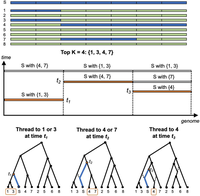
- Threads, for scalable reconstruction of ancestral recombination graphs and ARG-based genotype imputation.
- Quickdraws, for powerful mixed-model genome-wide association studies of quantitative and binary traits.
An ancestral recombination graph, or ARG, provides a compact representation of how different regions of a collection of genomes are related through common ancestors. Once reconstructed, these genealogies can be used to investigate population history, impute missing genetic variants and improve the detection of variants associated with complex traits.
Research software engineering
OxRSE’s contribution has combined scientific software development with performance engineering. Work across the collaboration has included:
- implementing scalable algorithms;
- developing high-performance C++ and Python software;
- optimising computationally intensive workflows;
- supporting parallel and GPU-accelerated analyses;
- creating reusable libraries and command-line tools;
- improving testing, packaging, documentation and reproducibility;
- preparing software for use with biobank-scale research infrastructure.
The resulting tools allow methods developed by the research group to be applied to datasets containing hundreds of thousands of individuals and millions of genetic variants.
Research impact
The software has contributed to several advances in statistical and population genomics.
FastSMC was applied to 487,409 UK Biobank participants, detecting approximately 214 billion identical-by-descent segments. These data revealed fine-scale patterns of genetic relatedness across Britain and supported association analyses involving ultra-rare variants.
ARG-Needle enabled the reconstruction of genome-wide genealogies for 337,464 UK Biobank participants. Genealogy-based analyses increased the number of rare and ultra-rare association detected across seven complex traits.
Quickdraws combines stochastic variational inference, a non-infinitesimal model of genetic effects and GPU acceleration. This makes it possible to improve mixed-model association power while retaining the computational scalability required for biobank datasets.
Threads extends this work with a highly scalable approach to ARG reconstruction. It is designed for datasets containing very large numbers of samples and variants and can also use inferred genealogies to support genotype imputation.
Selected software
- Quickdraws
- Threads
- ARG-Needle and arg-needle-lib
- FastSMC
Further details can be found on the dedicated Palamara Lab Software Page.
RSEs: Fergus Cooper, James Briant, Alex Allmont, Abhishek Dasgupta, Martin Robinson
Publications
Loya, H., Kalantzis, G., Cooper, F., and Palamara, P. F.
"A scalable variational inference approach for increased mixed-model association power."
Nature Genetics 57, 461–468 (2025). doi
OxRSE author: Fergus Cooper.
Zhang, B. C., Biddanda, A., Gunnarsson, Á. F., Cooper, F., and Palamara, P. F.
"Biobank-scale inference of ancestral recombination graphs enables genealogical analysis of complex traits."
Nature Genetics 55, 768–776 (2023). doi
OxRSE author: Fergus Cooper.
Nait Saada, J., Kalantzis, G., Shyr, D., Cooper, F., Robinson, M., Gusev, A., and Palamara, P. F.
"Identity-by-descent detection across 487,409 British samples reveals fine scale population structure and ultra-rare variant associations."
Nature Communications 11, 6130 (2020). doi
OxRSE authors: Fergus Cooper and Martin Robinson.
Gunnarsson, Á. F., Zhu, J., Zhang, B. C., Tsangalidou, Z., Allmont, A., and Palamara, P. F.
"A scalable approach for genome-wide inference of ancestral recombination graphs."
bioRxiv (2024). doi
OxRSE author: Alex Allmont.
Links
Palamara Lab website: https://palamaralab.github.io/
Software and documentation: https://palamaralab.github.io/software/
Public source code: https://github.com/PalamaraLab/

